The Trap
The Hostage Negotiation 🔒
Here is the darkest trick in the book. The healthcare industry knows that if they only threatened patients, we would have revolted years ago. So, they decided to threaten our parents' retirement instead.
Healthcare makes up nearly 18% of the US GDP. It represents a massive chunk of the S&P 500. UnitedHealth Group, CVS, and Big Pharma giants are "Blue Chip" stocks. They are the structural beams holding up the roof of the stock market.
This creates a "Mutually Assured Destruction" pact.
If we pass a law that lowers drug prices, Pfizer's stock drops. If we ban predatory insurance profits, UnitedHealth's stock crashes. And because your 401(k) and your pension fund are invested in "Total Market Index Funds," when their stock crashes, your retirement balance goes down.
They have successfully financialized their own bloat. Every dollar they steal from you in premiums counts as "Revenue" that boosts their stock price, which boosts your 401(k) slightly.
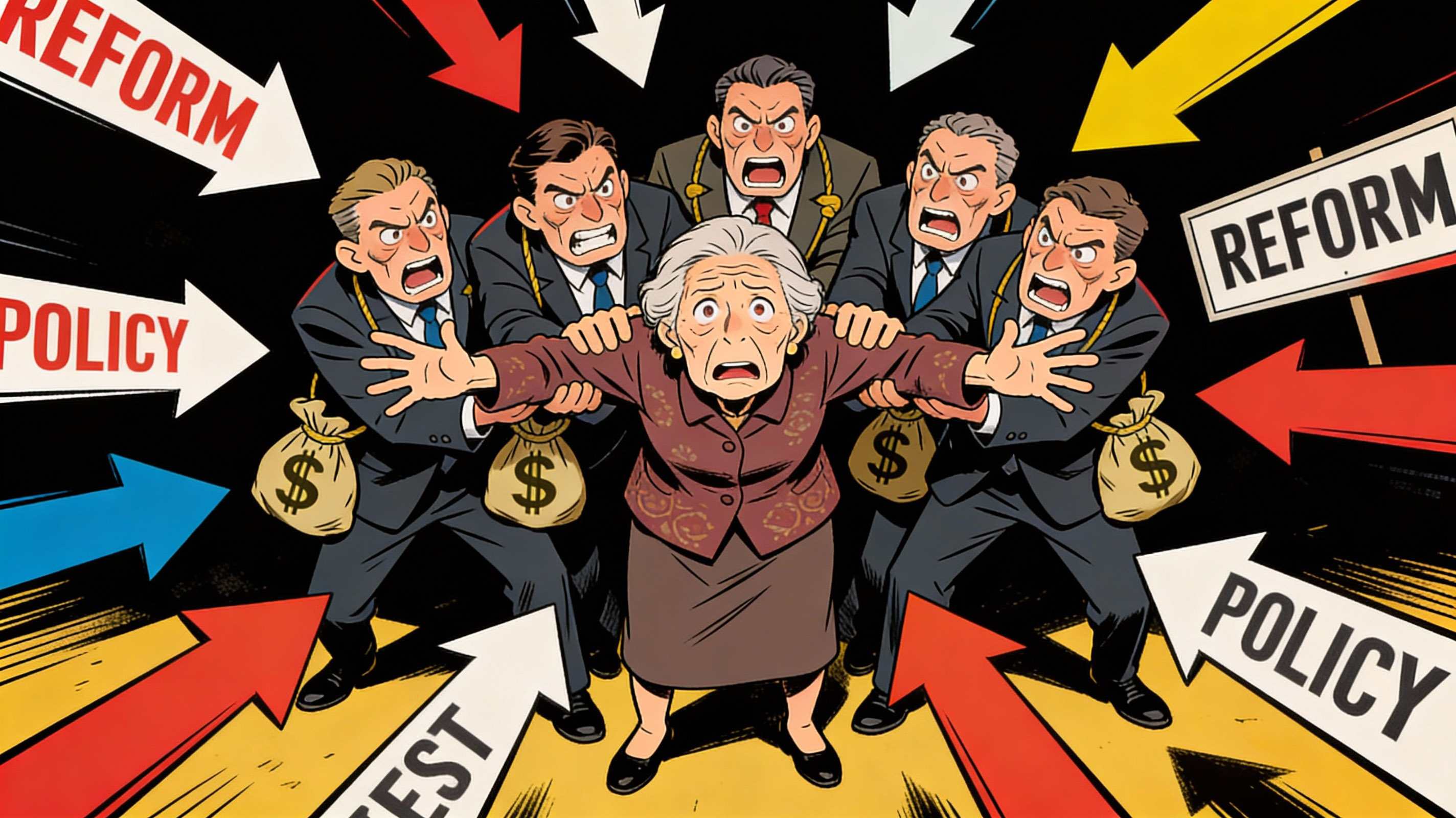
So, when politicians try to cut costs, the lobbyists don't talk about health. They walk into the office and say: "If you pass this, you will wipe out 15% of the Teachers' Pension Fund. Do you want to be the guy who bankrupts Grandma?"
The Trap: They are using your own savings as a human shield to protect their right to price-gouge you.
The Fix
The SAFEC+ Solution: The Golden Parachute for People, Not Stocks ✅
We accept the premise: The stock market values of these parasitic companies will drop. They should drop. A company that makes money by denying care should not be the engine of our economy.
But we protect the retiree, not the stock bubble.
1. The Retirement Income Exemption (Section 203) SAFEC+ introduces a specific firewall for retirees. While the new healthcare contribution applies to income, Section 203(b)(1)(B)(iv) creates a "Retirement Income Allowance."
2. The $100,000 Cap Under Section 203(b)(2), the first $100,000 of retirement distributions (from 401ks, IRAs, pensions) are completely exempt from the SAFEC+ contribution.
This means that even if the market wobbles during the transition, the tax burden on retirees is zero for the vast majority. Grandma pays nothing for her healthcare.
3. Replacing Costs with Savings Yes, the "Healthcare Sector" of the stock market will correct downward. But the "Consumer Discretionary" sector will explode upwards. Why because American workers and businesses are no longer spending $4.5 trillion a year on premiums and deductibles. That money flows back into the real economy—buying cars, renovating homes, and starting businesses.
We are popping a blister to let the patient walk again.
The Critics
"You Will Crash the Economy"
Wall Street will scream that wiping out insurance profits will cause a recession.
We are not destroying money; we are transferring it. We are taking money that was hoarded by administrative middlemen and giving it back to households and productive businesses. The "loss" to UnitedHealth is a "gain" to every other business in America that no longer has to pay extortionate premiums.
"Pension Solvency"
Union pension funds are heavily invested in healthcare stocks. A rapid drop could hurt their solvency ratios.
This is a legitimate short-term pain point. However, Section 1005 phases the implementation over several years. This gives fund managers a 7-year window to rotate their portfolios out of "Insurance Speculation" and into "Real Growth" sectors. The market is smart; it will price in the change before it happens.
The "Blue Chip" Void
Healthcare stocks are considered "defensive" (people buy meds even in recessions). Losing this safe harbor makes portfolios more volatile.
The Mitigation: True. But reliance on an industry that cannibalizes the rest of the economy is not "safety"; it is a slow suicide pact. We are trading the false stability of a monopoly for the dynamic growth of a healthy workforce.